


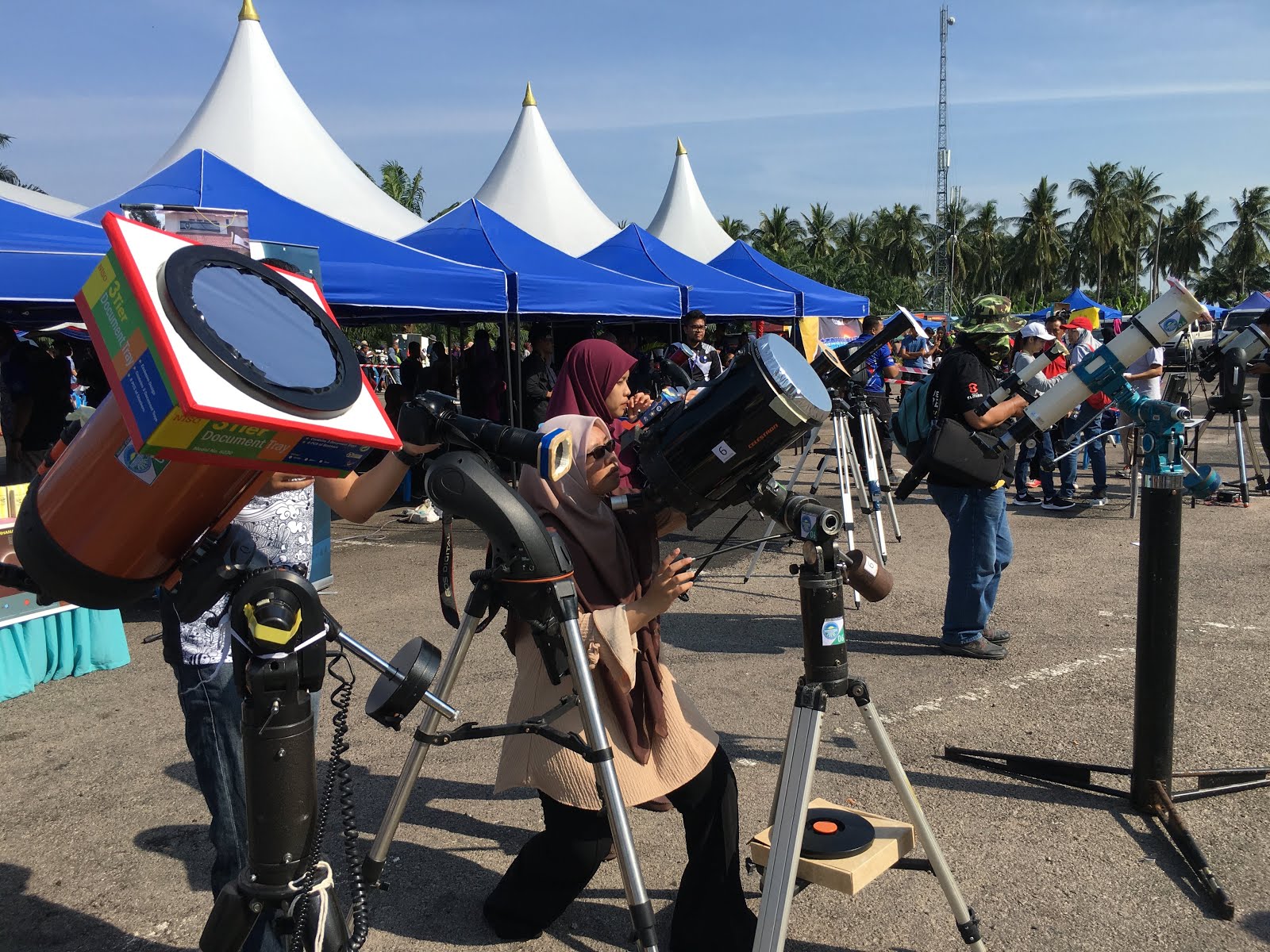


The purpose of the SEAAN Meeting is to bring together people working in the fields of astronomy and astrophysics from Southeast Asia. It aims to facilitate exchanges in both research findings and educational practices, as well as astronomy outreach efforts. The 2018 SEAAN Meeting consists of plenary talks and poster sessions over two days.
In conjunction with the meeting, there will also be an annular solar eclipse on 26 December 2019. This is an extremely rare event and a fitting occasion to celebrate astronomy in Southeast Asia. The details of the programme are found here: https://www.physics.nus.edu.sg/~seaan/
SST and NJC are represented by 8 students in 3 teams to present their research projects carried out under the mentorship of NJC and SST teachers.
Their articles were published in the The European Physical Journal (EPJ) Web of Conferences, Volume 240 (2020): The 11th Southeast Asia Astronomy Networking Meeting (SEAAN Meeting 2019)in Singapore, December 26-28, 2019. W.K. Ng, A. Yang, S.C.C. Ng, A.H. Chan and C.H. Sow (Eds.)
Our students’ research papers are found here:
Investigation of the Sudden Solar Ionosphieric Disturbance using Radiotelescopes
Low-frequency radio telescopes are cheap and useful devices for the investigation of terrestrial and extra-terrestrial emissions. These emissions come either from the Sun and the planet Jupiter to terrestrial emissions. We will deploy a few radios to investigate the VLF from mid-Sep to mid-December 2019. The radios used are Radiojove (20 MHz), INSPIRE (0-10 kHz) and SSID (3-30 kHz). The data collected will throw light on the atmospheric VLF conditions during that period.
Muhammad Adam Aqasha Bin Mohamed Hisham (SST, S3-06), Sneha Athreya (NJC)
Mentor: Mr. Tan Hoe Teck (SST)
Closing up onto our Sun: Solar imaging
Solar activity research provides insight into the sun's past, future (Science Daily, 2018). The solar activity includes observations of large numbers of intense sunspots, flares, and other phenomena; and demands a wide range of techniques and measurements on the observations. This research needs long term data collection before critical analyses can occur, to generate meaningful learning and knowledge. In this project, we will use solar imaging to make observations of solar activity, and take our baby-steps to make contributions in citizen science. Observations will be made in 4 wavelengths to gain a more thorough analysis by looking at different perspectives of the Sun, namely H-Alpha, Calcium-K, G-band, and white light.
Keith Chia Wen Kai (SST, S3-07), Shrivastava Kushagra (NJC), Wong Kang Jun (NJC)
Mentor: Ms. Ning Hwee Tiang (NJC), Mr. Alfred Tan (NJC, Vice-Principal)
Development of a Solar Storm Radio Telescope
Sudden Ionospheric Disturbances (SID) are transient changes in the ionosphere caused by enhancement in X-ray and EUV fluxes during solar flare events. The Solar Storm Radio Telescope is developed to detect SID via VLF remote sensing. The system, which consists of a loop antenna, preamplifier, and a computer, is able to detect VLF signals with frequencies between 3-30 kHz transmitted from various VLF stations around the Globe. The participants will also be investigating different methods to reduce the background noise in the data collection. This will help to ensure an accurate hit when there is a Sudden Ionospheric Disturbance.
Seow Kit Hint (SST, S3-02), Cao Shangyu (NJC), Gupta Arpit (NJC)
Mentor: Mr. Tan Hoe Teck (SST)


